


SOVEREIGN COMPLIANCE
CERTIFICATE OF COMPLIANCE-STATUTORY (DEFENSIBLE & ENFORCEABLE).
Supremacy Clause Enforcement Architecture
FEG’s Federal Standard for Preemption
The Ford Enterprises Group (FEG) is architected as a federal statutory utility—not a state‑defined business—governing disadvantaged‑business utilization under binding federal law.
Our paramount federal standard
- The FEG operates under statutory authority established by Public Law 95‑507 and 15 U.S.C. § 637(d), functioning as a disadvantaged orchestration utility under NAICS 541614.
- All references to federal mandates, subcontracting requirements, and socioeconomic utilization benchmarks reflect binding obligations imposed on prime contractors by statute and regulation.
This is not branding language—it is a Supremacy Clause anchor
- The source of authority is derived from federal statutes and regulations, rather than state commercial law.
- Its primary function is to serve as a disadvantaged‑business orchestration and compliance utility, not as a conventional revenue‑driven enterprise.
- The regulatory focus encompasses prime contractor obligations, subcontracting plans, and socioeconomic utilization benchmarks.
- Accordingly, all state‑level classifications are subordinate and must yield in the event of any conflict with federal objectives.
Supremacy Clause posture
- Under the Supremacy Clause of the U.S. Constitution, valid federal law is the “supreme Law of the Land.”
- For FEG, this means the federal purpose comes first: Public Law 95‑507 and 15 U.S.C. § 637(d) establish a framework for supporting disadvantaged businesses and enforcing subcontracting rules.
- State classifications take a back seat—any state-level approach that conflicts with or undermines this federal role is overridden.
- Likewise, corporate policies from prime contractors or platform partners can’t override or limit the federal obligations FEG is built to uphold.
- FEG’s system is designed to embed and enforce this hierarchy in every interaction.
FEG and the Texas Comptroller
- The Texas Comptroller’s office mainly works within state tax and franchise classification.
- FEG’s stance is that it’s not a typical commercial taxpayer, but rather a federal compliance coordination entity under NAICS 541614, dedicated to disadvantaged‑business participation and subcontracting enforcement.
- When conflicts arise, the federal purpose takes precedence.
- Any Comptroller designation that treats FEG like a standard profit‑driven business, creates hurdles to carrying out federal compliance, or misrepresents its statutory role is subject to federal preemption if it disrupts the disadvantaged‑business framework established by Public Law 95‑507 and 15 U.S.C. § 637(d).
- In practice, Texas tax and status labels may exist for administrative purposes, but they can’t override FEG’s federally defined identity or hinder its role as a disadvantaged‑business coordination utility.
FEG and the Texas Secretary of State
- The Texas Secretary of State handles entity registration, status, and corporate formalities.
- FEG’s view under the Supremacy Clause is straightforward: An entity’s status isn’t the same as its function—state records may list FEG, but they don’t define or limit its federal statutory role.
- Administrative actions like suspension, forfeiture, or misclassification that interfere with FEG’s ability to fulfill federal subcontracting and utilization mandates, or that mistake it for a purely commercial actor, are overridden by federal law and preempted when obstructive.
- FEG’s role as a disadvantaged orchestration utility continues by virtue of federal statute, regardless of the state’s administrative position.
What this means for prime contractors and partners
- For prime contractors and institutional partners, this Supremacy Clause framework offers clear guidance and protection.
- Federal obligations are binding, not optional—subcontracting requirements and socioeconomic utilization benchmarks are mandated by Public Law 95‑507 and 15 U.S.C. § 637(d), with FEG in place to put them into action.
- State-level inconsistencies are filtered out, as conflicting classifications don’t excuse noncompliance with federal rules.
- Acting as a federally aligned utility, FEG designs and oversees subcontracting plans, sets disadvantaged-business utilization benchmarks, produces audit-ready, regulator-grade documentation, and ensures performance meets federal enforcement standards—not state preferences.
- Simply put, prime contractors answer to federal law, and FEG is built to operate at that level.
Why FEG formalizes this on a public page
- This page is a public statement for regulators, making clear that FEG’s identity is rooted in federal authority and its role is compliance orchestration, not traditional commerce.
- Any classifications from the Texas Comptroller or Texas Secretary of State are purely administrative and cannot override FEG’s federal statutory position.
- For agencies, prime contractors, and oversight bodies, this is the definitive reference for FEG’s Supremacy Clause stance and its basis for preemption.
- As a disadvantaged orchestration utility, FEG helps federal agencies and prime contractors align subcontracting plans with legal requirements, turn socioeconomic goals into trackable results, and strengthen defenses against non‑compliance findings and enforcement actions.
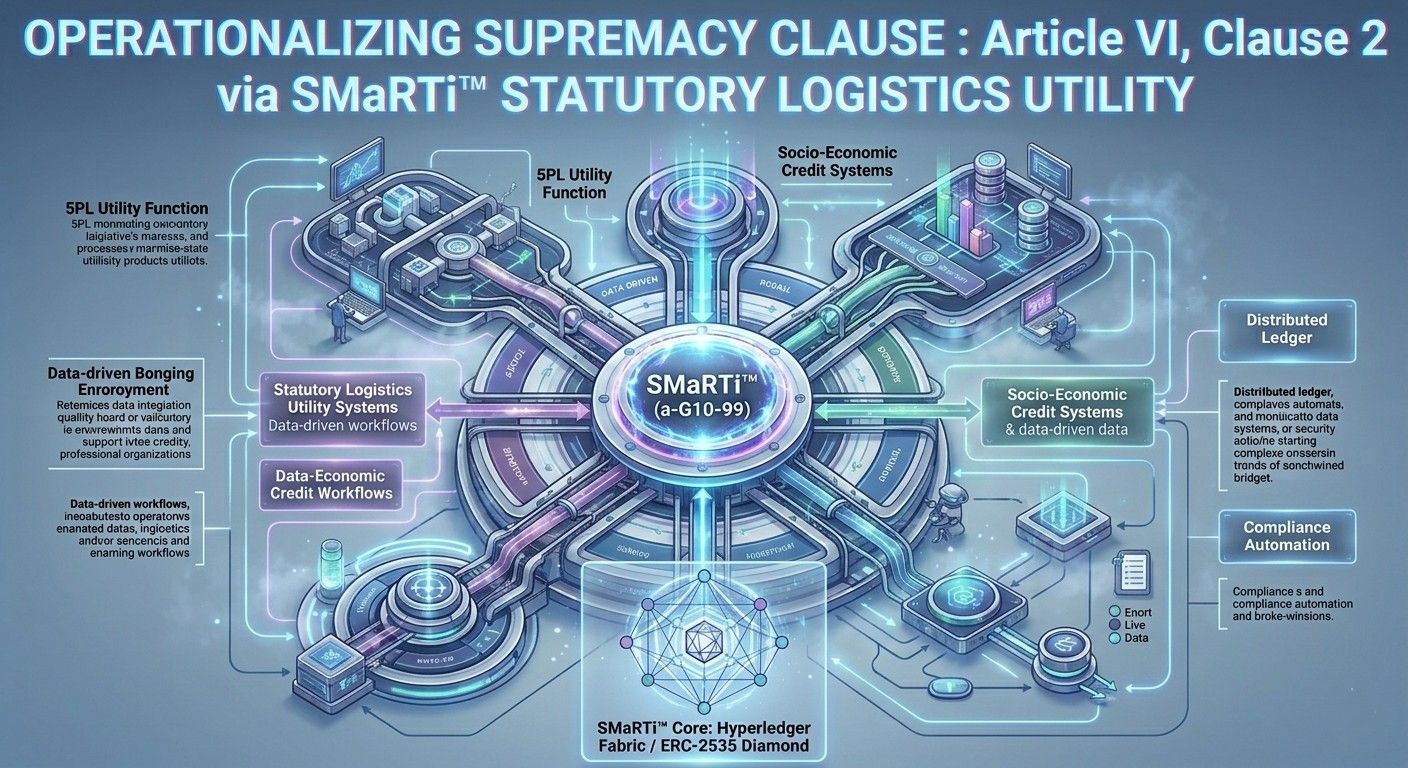
To start a federal‑aligned engagement as your disadvantaged orchestration utility under NAICS 541614, SMaRTi™ functions solely as a Statutory Governance Engine, or “Genesis Node,” through its SMaRTi™ (Statutory Mandate Automation & Regulatory Technology Infrastructure) SBIA, the "Small Business Innovation Architecture," Best Value (15 U.S.C. §637/FAR 15.101‑1) Hyperledger. The FEG Interoperability Framework (FIF) is built to put non‑discretionary statutory obligations into action.
